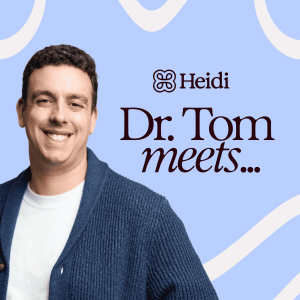
Dr Tom Meets...
A series of intimate chats between Heidi co-founder Dr Tom Kelly, Christina Farr and global leaders in the health and tech industries. Exploring how they think, decide and live with responsibility while on the cusp of rapid change.




Episodes

Jul 1, 2026
Jul 1, 2026
44 min
Carl Byers joins Tom and Christina to unpack what’s actually changing in healthcare as AI moves from hype to real world application.
From the “failure of imagination” phase of AI to the reality of investor expectations, Carl shares how he evaluates companies in a market where capital is no longer free and technology is increasingly commoditised. The conversation moves between venture dynamics, digital health’s overinflated past, and what it really takes to build something with durable value in healthcare.
It also expands beyond AI. From GLP-1s reshaping metabolic health to the limits of behaviour change, the discussion explores where real impact is likely to come from in the next 5, 10 and 20 years and whether the future of healthcare is driven by software, drugs, or a combination of both.
Key Themes
The “failure of imagination” phase of AI adoption in healthcare
What investors actually look for: traction, value creation and defensibility
The Indiana Jones theory of entrepreneurship (knowing where to dig)
Digital health’s overvaluation and the shift away from “free money”
Services vs software: why many health tech companies don’t deserve tech multiples
AI in clinical workflows vs administrative optimisation
The four AI agents of health: archive, diagnostician, planner and guide
Behaviour change limits and the reality of patient autonomy
GLP-1s vs AI: what will actually move outcomes
Global health system differences and why business models don’t translate
Links & Resources:
Connect with Carl:
Connect with Carl on LinkedIn
Check out the F-Prime Capital website: https://fprimecapital.com/
Connect with us:
Find all things Heidi at heidihealth.com
Connect with Heidi on LinkedIn
Connect with Dr Tom Kelly on LinkedIn
Connect with Christina Farr:
LinkedIn
Second Opinion Media website
Lifers Podcast
Twitter/X
Instagram
Resources:
Epic Systems (Referenced in discussion around data control & interoperability) https://www.epic.com
Athenahealth https://www.athenahealth.com

Jun 17, 2026
Jun 17, 2026
48 min
Tom and Christina sit down with AI researcher, Oxford academic and health equity advocate Maxine Mackintosh for a conversation about bias, power and what happens when healthcare innovation grows up.
They explore why the era of “sparkly innovation” in the UK has given way to hard questions about evidence and cost-effectiveness, how AI scribes became one of the first technologies clinicians actively pulled into practice, and why bias in AI isn’t just about models — it’s about the entire pipeline from data collection to post-market surveillance. From genomics datasets skewed toward European ancestry to language, culture and translation, Maxine makes the case that AI can both amplify inequity and create new opportunities for debiasing. The episode closes on a wider lens: billionaire influence, concentrated power, and why introducing friction — not removing it — might be key to preserving humanity in an automated future.
Key Themes
The shift from “innovation joy” to evidence and economic reality
Pull vs push adoption: why clinicians are demanding AI scribes
Bias across the full AI lifecycle
Genomics data imbalance (85% European ancestry datasets)
Language, culture and the limits of translation in clinical AI
Can AI debias medicine or will it scale existing inequities?
Concentrated wealth and power in health tech
Automation vs humanity: when to remove friction, and when to keep it
Links & Resources:
Connect with Maxine:
Connect with Maxine on LinkedIn
Connect with One HealthTech on LinkedIn
Check out the One HealthTech website: onehealthtech.com
Connect with us:
Find all things Heidi at heidihealth.com
Connect with Heidi on LinkedIn
Connect with Dr Tom Kelly on LinkedIn
Connect with Christina Farr:
LinkedIn
Second Opinion Media website
Lifers Podcast
Twitter/X
Instagram
Resources:
The Doctor (West End play referenced): https://almeida.co.uk/whats-on/the-doctor/
Polygenic Risk Scores and Ancestry Bias (PMC-Open Access): https://pmc.ncbi.nlm.nih.gov/articles/PMC9982687/
Open Notes (US transparency initiative referenced in discussion): https://www.opennotes.org/

Jun 3, 2026
Jun 3, 2026
38 min
Graham Walker and Joe Habboushe built MDCalc long before “health tech founder” was a career path. What began in 2005 as a simple way to avoid memorising risk scores has grown into one of the most widely used clinical decision tools in medicine, which is now used by 85% of US clinicians.
This conversation explores what it actually takes to build something that lasts in healthcare. They discuss emergency medicine as a breeding ground for founders, the ethics of monetising physician attention, why business models inevitably introduce bias, and how to structure companies so that money doesn’t distort mission. Through the lens of HBO’s The Pitt, they also debate AI in clinical documentation and why the right mantra for healthcare innovation might be: move fast, break nothing.
Key Themes:
Building MDCalc from a side project to 85% clinician adoption
Emergency physicians as overrepresented tech founders
Mission vs monetisation in clinical tools
“Biased money” and the ethics of physician mindshare
Advertising, EHR integrations, CME and hybrid business models
AI documentation risks and medication misattribution
“Move fast, break nothing” in healthcare
The duality of clinical practice and entrepreneurship
How to build something that lasts 20+ years
Links & Resources:
Connect with Graham and Joe:
Connect with Graham on LinkedIn
Visit Graham’s website: drgrahamwalker.com
Connect with Joe on LinkedIn
Follow MDCalc on LinkedIn
Check out MDCalc: mdcalc.com
Connect with us:
Find all things Heidi at heidihealth.com
Connect with Heidi on LinkedIn
Connect with Dr Tom Kelly on LinkedIn
Connect with Christina Farr:
LinkedIn
Second Opinion Media website
Lifers Podcast
Twitter/X
Instagram
Resources:
The Pitt (HBO): https://www.hbo.com/the-pitt

May 20, 2026
May 20, 2026
45 min
Daniel Kraft joins Tom and Christina for a conversation that moves from BioBERT to space medicine, from longevity hype to embryo screening ethics, and from full-body MRIs to the future of medical education.
Daniel frames AI as a super convergence (slowly, then all at once) where genomics, multimodal data, computational biology and intelligent agents are beginning to connect. The episode explores the tension between optimism and skepticism: stem cell tourism and snake oil, incidentalomas and anxiety, precision oncology and digital twins. It lands on a new model of future healthcare which is continuous, personalized and insight-driven. Where clinicians are augmented by intelligent systems and freed to focus on judgment, empathy and human connection.
Key Themes:
AI as super-convergence, not a single breakthrough moment
Precision oncology and the digital twin vision
Full-body MRIs: baseline insight vs incidentaloma risk
Data abundance vs actionable insight
Longevity hype, stem cell tourism and evidence gaps
Embryo screening, intelligence selection and Gattaca ethics
Generative health agents and always-on care models
Space medicine as a catalyst for remote monitoring
The “Waymo model” of on-demand healthcare
The future physician: empathetic, procedural, augmented
Links & Resources:
Daniel Kraft:
Find all things Daniel Kraft at danielkraftMD.com
Connect with Daniel on LinkedIn
Follow Daniel on Twitter/X @daniel_kraft
Check out NextMed.Health
Join the Digital Health Community
And Continuumhealth.vc
Connect with us:
Find all things Heidi at heidihealth.com
Connect with Heidi on LinkedIn
Connect with Dr Tom Kelly on LinkedIn
Connect with Christina Farr:
LinkedIn
Second Opinion Media website
Lifers Podcast
Twitter/X
Instagram
Resources:
Jivi AI (India health super-intelligence platform): https://www.jivi.ai
Yamanaka Factors (Cellular Reprogramming): https://www.nature.com/articles/nature05934
Full-Body MRI Debate BMJ – Overdiagnosis in Modern Medicine: https://www.bmj.com/content/344/bmj.e3502
Stem Cell Tourism Risks (FDA Warning): https://www.fda.gov/media/85776/download

May 6, 2026
May 6, 2026
54 min
Stephen Klasko’s career doesn’t follow a straight line. From disc jockey, to OB-GYN, medical school dean, health system CEO, and venture investor, this unconventional arc is what gives him the vantage point to dissect American healthcare not as a critic on the sidelines, but as someone who has run one of the largest academic health systems in the country and tried to change it from the inside.
This conversation moves from maternal health inequities and malpractice pressures to employer sponsored insurance, perverse financial incentives, and why the U.S. spends more than any other country while outcomes lag. Klasko reflects on leading Thomas Jefferson University, redesigning incentives around health inequities, partnering with venture, and why technology alone won’t fix a system built around sick care. He argues for training a different kind of clinician, rethinking insurance at the state level, and even launching a “911 Commission for Healthcare” to confront structural failure head-on.
Key Themes & Topics:
From DJ to Dean: Klasko’s unconventional path into academic leadership
Maternal health in the U.S.: high spending, poor outcomes, and structural inequity
Medicaid cuts, hospital margins, and the financial siege facing nonprofit systems
Selling to health systems: why startups must tie innovation to measurable cost, quality, access, and margin impact
The case for a 911-style commission to rethink U.S. healthcare from first principles
Links & Resources
Connect with Stephen Klasko:
For everything Stephen Klasko: https://sklasko.com/
Stephen Klasko (LinkedIn): https://www.linkedin.com/in/sklasko
Stephen’s books, including ‘UnHealthcare: A Manifesto for Health Assurance’: https://sklasko.com/books/
General Catalyst: https://www.generalcatalyst.com/
Connect with us:
Find all things Heidi at heidihealth.com
Connect with Heidi on LinkedIn
Connect with Dr Tom Kelly on LinkedIn
Connect with Christina Farr:
LinkedIn
Second Opinion Media website
Lifers Podcast
Twitter/X
Instagram

Apr 22, 2026
Apr 22, 2026
43 min
For decades, medicine rewarded stability, hierarchy and certainty. Now, a growing subset of clinicians are stepping away from traditional pathways to build companies, invest in startups and reshape healthcare from the inside.
Dr Tom and Christina Farr, sit down with Rebecca Mitchell to unpack what’s changed. From “burning the boats” and letting medical licenses expire, to building venture firms powered by frontline clinicians, this conversation explores why medicine is producing a new archetype: the clinician founder.
They examine founder psychology, product led growth in healthcare, storytelling as a strategic advantage, and why the next era of healthcare innovation may be led by doctors who want more agency, not an escape route.
Key Themes & Topics:
The emergence of a new clinician archetype: operator, investor, builder
“Burning the boats” and walking away from safe, prestigious medical careers
The mindset shift behind high potential clinician founders
Product-led growth in healthcare
Storytelling as founder leverage
Clinician powered investing and why capital allocation needs frontline insight
Links & Resources
Connect with Rebecca Mitchell:
Rebecca Mitchell’s LinkedIn: https://www.linkedin.com/in/rebeccalynnmitchell
Clinician powered venture firm, Scrub Capital: https://scrubcapital.com/
Connect with us:
Find all things Heidi at heidihealth.com
Connect with Heidi on LinkedIn
Connect with Dr Tom Kelly on LinkedIn
Connect with Christina Farr:
LinkedIn
Second Opinion Media website
Lifers Podcast
Twitter/X
Instagram
Resources:
Doximity (example of physician PLG model) https://www.doximity.com
Feb 27, 2026
Feb 27, 2026
2 min
Dr Tom Meets is landing in your podcast app soon.
Subscribe now - so you don't miss an episode.